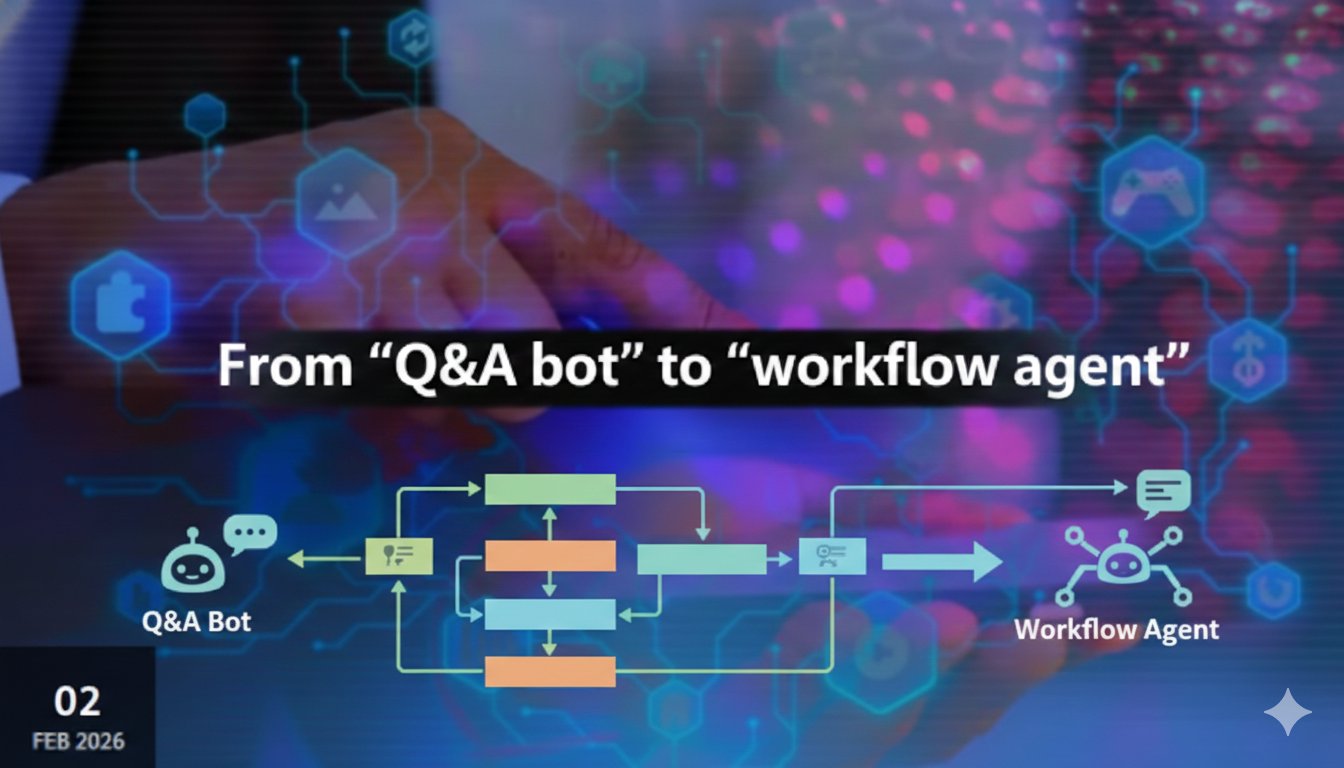
From “Q&A bot” to “workflow agent”
Most organisations begin their GenAI journey with a simple and sensible goal: building a bot that can answer questions from internal documents. At Leader Group, this is usually the first step organisations take because it feels safe, familiar, and easy to measure. Employees can ask policy questions, find instructions, and reduce repetitive follow-ups.
This first step also builds confidence. Users learn how to ask better questions, content owners discover gaps in documentation, and leaders start seeing where time is being lost. Leader Group has observed that very quickly, expectations grow. People don’t just want answers anymore, they want work to move forward.
They ask whether the bot can draft a ticket, fill a form, collect missing details, route a request, or update a system. This is where the shift happens, from a simple Q&A bot to a workflow agent. The right way to make this shift is not by jumping straight into autonomy, but by moving step by step, with each stage adding value while strengthening trust and control.
AI agents usually don’t fail because the model is weak. In Leader Group’s experience, they fail when processes are unclear, approvals are missing, and teams don’t trust what the system is doing.
Why a maturity ladder matters
Teams typically fall into one of two traps. Some remain stuck at Q&A, where the system is helpful but the impact feels limited. Others try to jump straight to an autonomous agent that can act across enterprise systems. Leader Group frequently sees this jump lead to predictable problems: incorrect actions, poor traceability, security concerns, and a rapid loss of trust.
Once trust is lost, adoption drops, and even a technically strong system stops being useful.
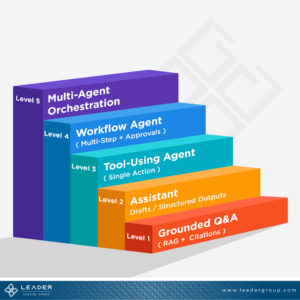
A maturity ladder (ref Fig 1) avoids these issues. Leader Group’s approach treats capability as something that is earned. Each level makes the system more useful while adding the safety and structure needed for the next stage.
Level 0: Knowledge readiness before AI
The most important stage is also the least exciting. Before AI, knowledge itself needs attention. If policies and procedures are scattered, outdated, or inconsistent, adding AI will only amplify confusion. This stage is about agreeing on sources of truth, assigning ownership, versioning documents, and ensuring people know where to find the latest guidance.
Even without AI, this improves search and reduces friction. More importantly, Leader Group emphasises that it prepares the ground for AI to answer questions responsibly.
Level 1: Grounded Q&A with citations (the trust-building stage)
A good Q&A bot does more than sound confident. It retrieves relevant information and answers using that context, ideally showing where the answer came from. This approach builds trust because users can verify what they see.
At this level, behaviour changes quickly. People start asking small, everyday questions they would otherwise interrupt colleagues for. When the bot shows clear sources, confidence grows. When it cannot find reliable information and says so honestly, trust increases rather than decreases.
The key metric here is not just answer quality, but citation quality. Leader Group has found that useful citations are what bring users back.
Level 2: An assistant inside the workflow (useful without being risky)
Once Q&A works well, the next opportunity becomes obvious: helping people do routine work faster without acting on their behalf. At this stage, the system becomes an assistant that produces structured outputs. It can draft IT tickets, extract required fields from emails, prepare onboarding checklists, or summarise case histories.
The user remains in control. The assistant reduces effort and improves consistency. Leader Group sees this level often deliver the highest return for the least risk. It also forces teams to solve practical questions around structured outputs, validation, and audit trails.
Culturally, this is where users stop seeing the bot as a novelty and start treating it as part of how work gets done.
Level 3: Tool-using agents (the moment the system can “do” something)
This is the turning point. The system begins interacting with tools and APIs. It can create tickets, fetch records, check statuses, or update fields in controlled systems. The interface shifts from language to action.
When done carefully, this is powerful. When done casually, it is risky. That is why strong boundaries are essential. The agent must have a limited set of allowed tools, strict permissions, clear logging, and protections against duplicate actions. Actions often begin in preview or pending states so humans remain in control.
At this stage, Leader Group notes that security becomes a real operational concern. Once an agent can affect systems, safeguards are no longer optional.
Level 4: Workflow agents with approvals and exception handling
A workflow agent goes beyond single actions. It can manage multi-step processes, handle missing information, request approvals, and respond to exceptions. It can interpret intent, gather details, check policies, propose actions, and execute only after the right approvals are in place.
For example, in procurement it may gather role and budget details, validate policy constraints, route approvals, and only then raise a purchase request. In IT operations, it may analyse logs, suggest a runbook step, request permission, and execute while recording every change.
Here, Leader Group stresses that governance becomes part of the system design. Clear approval rules, escalation paths, and monitoring are essential. This is no longer about adding warnings in the interface, but about building accountability into the workflow.
Level 5: Multi-agent orchestration (when one agent is no longer enough)
Not every organisation needs this level. It becomes valuable when workflows are complex and span multiple domains. Instead of one agent doing everything, responsibilities are split across specialised agents such as retrieval, policy checking, execution, and verification.
Leader Group recognises that this improves reliability but also adds complexity, so it should be adopted only when justified.
What makes people actually trust agents
People rarely reject AI because they dislike technology. They reject systems that feel unsafe or unpredictable. Trust grows when users can see sources, understand why actions happened, and remain in control of high-impact decisions.
Trust collapses when an agent acts confidently without evidence, bypasses approvals, or makes mistakes that cannot be explained.
This is why, from Leader Group’s perspective, the maturity ladder is as much about people and operations as it is about models. The most successful agent systems are not the most impressive in demos. They are predictable, explainable, and fit naturally into existing ways of working.
A practical starting path (that avoids the common traps)
A sensible rollout starts small. Choose one domain with clear value and manageable risk. Leader Group recommends beginning with grounded Q&A to build trust and improve knowledge quality. Add structured assistance inside workflows to save time. Introduce one safe tool action in a controlled state.
Only after these are stable should full workflow automation be considered.
Prove value early, strengthen the foundations, and then earn autonomy.
Closing thought
A Q&A bot helps people find information. A workflow agent helps people finish work.
The maturity ladder is how organisations move from answers to outcomes without losing trust, safety, or control. Leader Group sees that teams that treat agents as an operational capability rather than a demo are the ones that achieve lasting improvements in day-to-day productivity.
For more information on enterprise AI, agent maturity, and practical adoption, reach out to Leader Group or Visit www.leadergroup.com/contact-us/ to learn more.